REVIEW · ROME
COMBO: Rome’s Capuchin Crypts Tour & Rome’s Dark Side Ghost Tour
Book on Viator →Operated by Dark Side City Tours · Bookable on Viator
Bones and ghosts. Right in the middle of Rome. This combo strings together two very different kinds of eeriness, from the Capuchin Crypts (3,500 skeletons) to street-corner legends tied to murder, execution, and wartime tragedy. You’ll move through central landmarks with an English-speaking guide and a mobile ticket, all in about four hours.
I particularly like how small group size (max 15) keeps the vibe personal. I also love that the stories don’t stay stuck in the distant past. You’ll go from a Second World War tragedy near Via Rasella to darker angles on famous stops like the Trevi Fountain, Piazza Navona, and the Pantheon area—served with the kind of storytelling guides like Ben, Ivana, and Alethea have been praised for.
One consideration: this is a dark tour in the real sense. You’ll be seeing bones up close and hearing execution-and-loss stories, so if you’re squeamish or planning around very young kids, you may want to think twice.
In This Review
- Key highlights worth your time
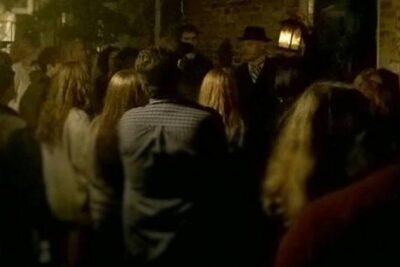
- The 5:00 pm start makes the dark stories feel more believable
- Entering the Capuchin Crypts: skeletons, design, and why it exists
- Via Rasella and the Trevi Fountain: famous places with darker side-stories
- Via Rasella: WWII tragedy in a modern-dark pocket
- Trevi Fountain: beauty plus longing, murder, and possible haunting
- The Pantheon area and Piazza Navona’s haunted window
- Piazza della Rotonda: the Pantheon’s neighbor with a gruesome past
- Piazza Navona: 2,000 years, plus stories like haunted glass
- Campo de’ Fiori, Vicolo delle Grotte, and Ponte Sisto: Bruno, a magician, and a bridge ghost
- Campo de’ Fiori: Giordano Bruno’s unhappy statue
- Vicolo delle Grotte: a self-proclaimed magician who never left
- Ponte Sisto: a woman who rose from poverty to rule Rome
- Santa Maria dell’Orazione e Morte and Via di Monserrato: monks, funerary work, and prison whispers
- Via dei Banchi Vecchi to Via del Banco di Santo Spirito: poison and the official executioner
- Via dei Banchi Vecchi: a prolific poisoner’s story and motives
- Via del Banco di Santo Spirito: executioner for over 60 years
- Castel Sant’Angelo as the finale: Cenci family, judgment, and lingering questions
- Price and logistics: is $66.01 a good value for 4 hours?
- Who should book this dark-side combo?
- Should you book Rome’s Capuchin Crypts and Dark Side Ghost Tour?
- FAQ
- How long is the Rome Capuchin Crypts Tour & Dark Side Ghost Tour combo?
- How much does it cost?
- What language is the tour in?
- Is the Capuchin Crypt admission included?
- Where do I meet and where does the tour end?
- How big is the group?
Key highlights worth your time
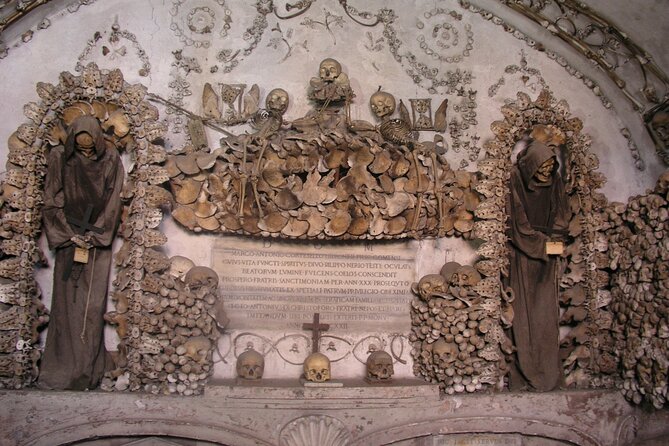
- Capuchin Crypts (3,500 skeletons): macabre art and a guide-led explanation, with admission included
- A tight, max-15 group: more attention, less waiting around, and quicker story focus
- Famous sights with a darker lens: Trevi Fountain, Pantheon area, Piazza Navona, and more
- Modern dark history, not just ancient Rome: Via Rasella connects the stories to WWII
- Execution-era stops build to a finale: you end at Castel Sant’Angelo, tied to the Cenci family
The 5:00 pm start makes the dark stories feel more believable
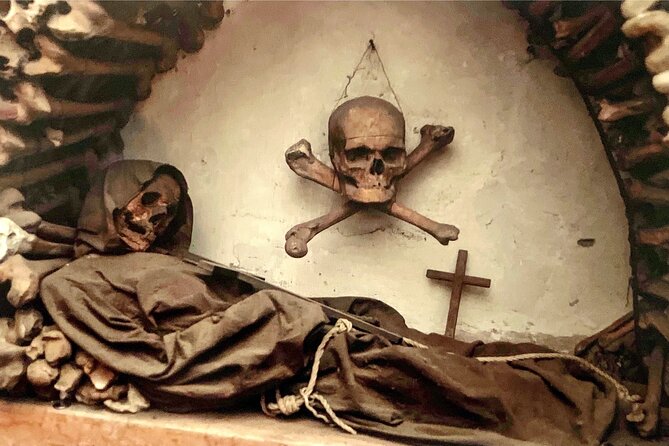
This tour combo starts at 5:00 pm, meeting at Via Vittorio Veneto 19 and ending at Castel Sant’Angelo. Timing matters here. Rome’s center shifts after late afternoon: crowds change, shadows get longer, and the walk between squares and streets feels more like a story you’re actively walking through, not a checklist.
You’re also getting a rare format: two different moods in one outing. First comes the Capuchin Crypts stop—still, close-up, and bone-bedecked. Then the tour pivots to street legends and darker local tales as you weave through the city center toward Castel Sant’Angelo.
With a duration of about four hours and a walk that includes “travel time between each stop,” plan to stay in tour mode. This isn’t just a sit-and-listen experience. You’ll be standing in public spaces, looking at buildings and landmarks, and letting the guide connect the dots as you move.
You can also read our reviews of more tours and experiences in Rome.



Entering the Capuchin Crypts: skeletons, design, and why it exists
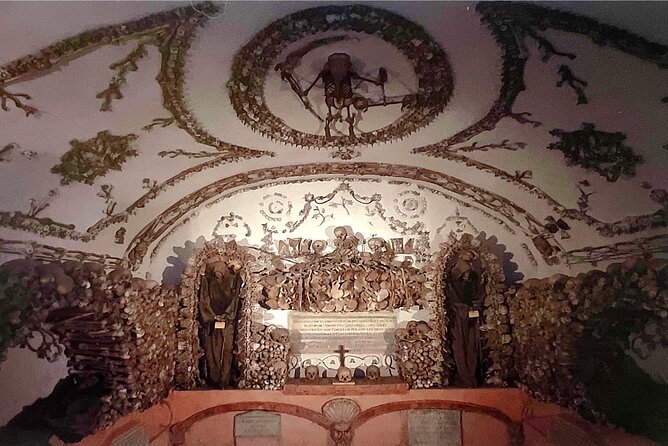
Stop 1 is the Museum and Crypt of the Capuchin Friars, with 40 minutes there and the Capuchin Crypt entrance fee included. The headline is simple: you’ll explore an eerie collection associated with 3,500 skeletons. But what makes it worth booking is that you’re not just staring at remains—you’re getting the story behind how this place came to be and what it means.
This is the kind of site that can feel either shocking or fascinating, depending on how it’s framed. A good guide matters, and the combo’s top-rated feedback repeatedly points to strong storytelling and care—people liked that guides shared details most tours typically skip. In the crypt, that attention is especially important because it’s easy to miss what you’re seeing once you’re focused purely on the shock factor.
Practical expectation: you’ll spend a meaningful chunk of your total tour time here, and it’s the emotional anchor of the whole combo. If you’re traveling with teens, this is often where the “real history” part lands, because the visit is concrete and visual. If you’re sensitive to the macabre, this is also the part you’ll want to mentally prepare for.
Via Rasella and the Trevi Fountain: famous places with darker side-stories
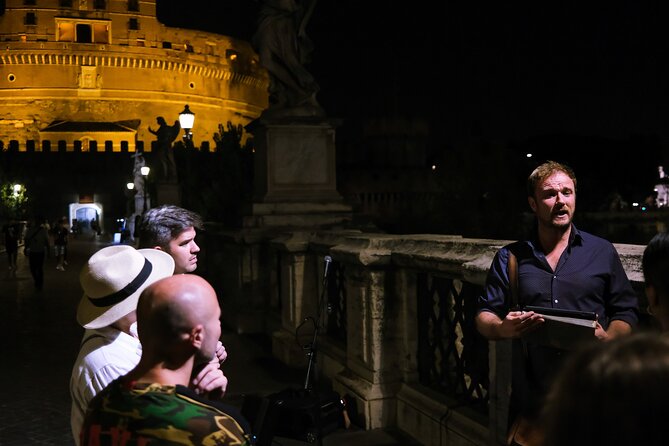
After the crypt, the tour becomes a walking narrative through Rome’s center—short stops that act like chapters.
Via Rasella: WWII tragedy in a modern-dark pocket
Stop 2 is Via Rasella for about 5 minutes. The story here is described as one of Rome’s more modern dark tales, tied to a tragic event during the Second World War. This matters because so many “ghost tours” lean heavily on medieval or ancient legends. Here, you get a shift in time periods, which makes Rome’s darkness feel ongoing, not locked into the past.
Trevi Fountain: beauty plus longing, murder, and possible haunting
Stop 3 is Trevi Fountain for about 10 minutes, and it’s where the tour reframes a global postcard. You’ll hear a darker tale connected to longing and murder, plus why it’s possibly still haunted today. You’ll see Trevi in the usual way—crowds, faces, the landmark energy—but with a different story lens.
What I like about this approach is that it helps you notice the space differently. Instead of just taking photos, you’re listening for the human motive behind the legend. The tour doesn’t ask you to treat the fountain as purely magical. It presents a “why this story sticks” angle, which makes the whole thing feel more grounded.


The Pantheon area and Piazza Navona’s haunted window
The next pair of stops are compact but packed with “look closer” moments.
Piazza della Rotonda: the Pantheon’s neighbor with a gruesome past
Stop 4 is Piazza Della Rotonda, roughly 10 minutes. The Pantheon is the star across the way, but the guide turns attention to what’s directly opposite: a building with a gruesome past, said to have inspired similar legends around the world. Even if you don’t leave with a single definitive answer, you’ll come away with a better sense of how legends can spread—through real settings and memorable details.
Piazza Navona: 2,000 years, plus stories like haunted glass
Stop 5 is Piazza Navona for about 20 minutes. This square is described as having a 2000-year history, and naturally it comes with darker tales. Two are highlighted here: a haunted window, and a mysterious marble head watching over the square even now.
This is a great stop for a combo tour because it blends scale with specificity. You’re in a major landmark space, but the guide points you to particular features to watch for. That’s where small group size helps: you’re less likely to be lost in the crowd and more likely to catch the fine points as they’re explained.
Campo de’ Fiori, Vicolo delle Grotte, and Ponte Sisto: Bruno, a magician, and a bridge ghost
Now the tour leans harder into legend and character.
Campo de’ Fiori: Giordano Bruno’s unhappy statue
Stop 6 is Campo De’ Fiori, about 15 minutes. The story centers on Giordano Bruno and how his scientific and philosophical theories weren’t well received by the Church. Even the statue’s expression is part of the setup: you’ll be told why it doesn’t look so happy.
If you want one reason this combo feels worth it beyond the Capuchin Crypts, it’s moments like this. You walk into a square that you might have visited casually before, then you leave with a clearer picture of how ideas—and punishments—can live on in stone.
Vicolo delle Grotte: a self-proclaimed magician who never left
Stop 7 is Vicolo delle Grotte for about 10 minutes. You’ll hear the tale of a self-proclaimed magician said to still haunt the street. The advantage of placing this story in a narrow lane is obvious. It’s easy for the mood to match the message: the darkness feels less abstract when the street itself is tight and close.
Ponte Sisto: a woman who rose from poverty to rule Rome
Stop 8 is Ponte Sisto, about 10 minutes. Here, the legend is about a woman who rose from poverty to rule Rome, and is reputed to haunt the bridge. The tour sets you up to look for chills—then lets you decide if the story feels convincing.
This stop is also a nice pacing reset. After squares, you get an open view line from the bridge area before the tour continues deeper into churches and streets tied to imprisonment and punishment.
Santa Maria dell’Orazione e Morte and Via di Monserrato: monks, funerary work, and prison whispers
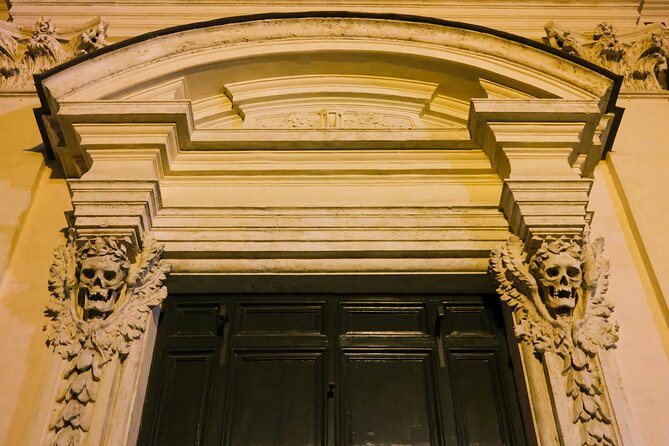
Stop 9 is Chiesa di Santa Maria dell’Orazione e Morte for about 10 minutes. It’s described as having unusual decoration, and monks with an unusual role in public life. Even without turning it into a gore-fest, this is exactly the kind of location where a guide’s explanation can transform what you see. Church exteriors and interiors in Rome can look like they’re all the same until someone tells you what to notice.
Stop 10 is Via di Monserrato for about 10 minutes. The story here is tied to a prison: this street was once home to a notorious prison, and the tortured souls are said to still be heard. This is another “why this matters” moment. It’s not just the act of hearing a ghost story. It’s the idea that city geography remembers what happened there.
Via dei Banchi Vecchi to Via del Banco di Santo Spirito: poison and the official executioner
This is where the combo leans into “dark history with names and roles.”
Via dei Banchi Vecchi: a prolific poisoner’s story and motives
Stop 11 is Via dei Banchi Vecchi for about 10 minutes. You’ll hear the story of one of the most prolific poisoners in history and why some may think she was doing the best job for the women of Rome.
That wording matters for how the tour feels. It doesn’t only present villains as monsters. It frames motive and survival inside a system. It’s a darker angle, sure, but it’s also a reminder that punishment and power often twist ordinary lives.
Via del Banco di Santo Spirito: executioner for over 60 years
Stop 12 is Via del Banco di Santo Spirito for about 10 minutes. This place was once home to Rome’s official executioner, with the guide describing the job as lasting over 60 years. Expect a story meant to shock, focused on the executioner’s life.
This part is effective in a combo tour because it connects themes. From poison to execution, the tour keeps returning to what happens when someone is powerless—or when the system assigns someone power through cruelty.
Castel Sant’Angelo as the finale: Cenci family, judgment, and lingering questions
Stop 13 is Castel Sant’Angelo, with about 10 minutes. The setting is tied to execution history, and the bridge to Castel Sant’Angelo is described as possibly still haunted by the victim of one of Rome’s most tragic tales: the Cenci family. The guide essentially asks you to judge whether they were in the right.
Ending here makes a lot of sense. You finish where the city’s punishment history is built into the landscape. Plus, the tour’s final stretch gives you that “I’ve been hearing about death and power all night, now I’m standing where it happened” feeling—without turning it into a lecture.
Price and logistics: is $66.01 a good value for 4 hours?
At $66.01 per person for about 4 hours, this combo can feel like a solid value—especially because the Capuchin Crypt entrance fee is included. That matters more than it sounds. Tours that don’t include the main ticket often end up costing more once you add admissions.
You’re also getting value from time. The itinerary is packed with short, focused stops rather than long transit waits. Most of the duration is spent moving through central Rome and hearing stories as you go. The small group limit of 15 also increases the odds that the guide can keep your questions and your attention in play.
Language is another practical point: it’s offered in English. If that’s your only option, it’s good to know it’s built for that language rather than shoehorned into it.
One more plus: the tour uses a mobile ticket, which is convenient. And while the tour isn’t “museum-heavy” after the crypt, it does give you multiple landmark moments—Trevi, Pantheon area, Piazza Navona—so you’re not investing money into one single site only.
Who should book this dark-side combo?
Book it if you want Roman sightseeing with a sharper edge and a guide who tells stories with pacing. It’s especially appealing if you like:
- Macabre but explained: the Capuchin Crypt isn’t just bones; you get the story behind them
- Attention to detail: the combo is praised for guides sharing unique specifics
- Teen-friendly energy: at least one guide experience was noted as engaging for teenagers
You might want to skip it (or at least think hard) if you’re not comfortable with graphic imagery or execution-related stories. This tour is built around darkness, not around gentle “spooky” vibes.
Also consider your tolerance for walking between stops. The itinerary totals about four hours with walking included, and much of it takes place in public squares and streets. If you prefer indoor, seated attractions only, this won’t match your style.
Should you book Rome’s Capuchin Crypts and Dark Side Ghost Tour?
If you’re doing only a few guided tours in Rome, this one is a strong candidate because it covers two kinds of Rome-at-night energy: the physical reality of the crypt and the psychological reality of legends. The fact that it holds a 5/5 rating with 100% recommendation doesn’t guarantee it fits everyone, but it does suggest the format works—especially the combination of storytelling, small-group attention, and a clear sense of where the night is going.
If you want the simplest decision rule: book it if you’re curious about Rome’s darker layers and you don’t mind that the stories are meant to feel unsettling. Skip it if you want light and fluffy history only.
FAQ
How long is the Rome Capuchin Crypts Tour & Dark Side Ghost Tour combo?
It lasts about 4 hours.
How much does it cost?
The price is $66.01 per person.
What language is the tour in?
The tour is offered in English.
Is the Capuchin Crypt admission included?
Yes. Capuchin Crypt Entrance Fee is included, and the crypt stop has an admission ticket included.
Where do I meet and where does the tour end?
You start at Via Vittorio Veneto, 19, 00187 Roma RM, Italy and end at Castel Sant’Angelo, Lungotevere Castello, 50, 00193 Roma RM, Italy. The start time is 5:00 pm.
How big is the group?
The tour has a maximum of 15 travelers. A smaller group usually means more attention from the guide.