REVIEW · TORONTO
Toronto Old Town: Self-Guided Dark History Walking Game
Book on Viator →Operated by Questo · Bookable on Viator
Toronto has a dark side you can walk. This self-guided route is built around 10 puzzle challenges, so you control the pace while you hunt answers in some of the city’s most important buildings. I also like that it works as a group bonding activity—bring friends or family and keep the momentum going together. One thing to consider: there is no physical guide, so you’ll be doing the reading and the looking yourself as you follow the app.
You start at Toronto City Hall and finish at St. Lawrence Market, with step-by-step directions from the Questo app. It’s also designed for real-world travel: once you download, you can keep going without Wi‑Fi for the rest of the quest, and you can pause and resume whenever your group needs a breather.
In about 1 hour 30 minutes, you’ll pass a mix of civic power, banking-era architecture, hotel glamour, sports legend, and old-school places where people gathered. If you like city history but don’t want a rigid schedule, this format is a smart way to see Toronto on your terms.
In This Review
- Key things I’d plan for before you start
- How the Questa game really feels in Toronto (and why it’s good)
- City Hall to the Pan Am-era sign: start with civic power and a scavenger eye
- Old City Hall: courts, government, and why buildings get political
- TD Centre and Oscar Peterson Place: finance-era scale, then public art
- Fairmont Royal York: luxury history meets a clue-based walk
- Hockey Hall of Fame in a former Bank building: sports history with a twist
- King Edward Hotel and St. James Cathedral: architecture built to last
- St. Lawrence Hall to St. Lawrence Market South: finish where the city meets itself
- Price and time: value for a 90-minute self-guided dark history walk
- Should you book this Toronto Old Town dark history walking game?
- FAQ
- What is the duration of the Toronto Old Town self-guided dark history walking game?
- How much does it cost per person?
- What does the tour include?
- Do I need Wi‑Fi during the walk?
- Where does the experience start and end?
- What language is the experience offered in?
- Is there a physical tour guide?
- Is free cancellation available?
Key things I’d plan for before you start
- Plan for phone-first navigation: the Questo app gives step-by-step guidance to your next stop.
- Get ready for a scavenger-hunt feel: each location has a look-around challenge that advances you.
- Work in your downtime: you can pause and resume during the experience.
- Save your data plan: no Wi‑Fi needed after the initial download.
- Use it for group time: it’s designed for friends and family to do together, with group discounts.
How the Questa game really feels in Toronto (and why it’s good)
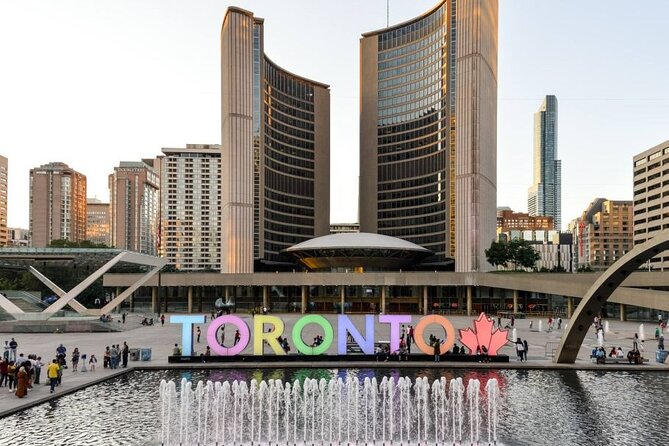
This isn’t a traditional guided walk where one person talks and you follow. This is a structured city exploration where the app plays the role of guide. You’ll start at Toronto City Hall (100 Queen St W), then move location to location, using your phone to answer challenges and find the next destination.
What I like about this setup is that it fits how most people actually travel. You can slow down for a photo. You can speed up if your group is on a roll. You can pause if someone needs a snack, coffee, or a quick restroom stop. That flexibility matters in a downtown route where street corners, crowds, and construction can change your rhythm fast.
The experience is also designed to be low-friction tech-wise. You get a mobile access code, and the app handles the storyline content about Old Town’s darker side. Since it doesn’t require Wi‑Fi after download, you can plan to download before you head out, then spend your time walking instead of hunting a signal.
You can also read our reviews of more tours and experiences in Toronto.



City Hall to the Pan Am-era sign: start with civic power and a scavenger eye
You begin at Toronto City Hall, a logical kickoff if you’re in a history mood. Even before you move, you’ll be in the thick of downtown governance: this is where the city’s public face sits and where major institutions tend to cluster.
From there, the first challenge pulls you toward a sign that has its own story. It was installed for the 2015 Pan American Games as a temporary attraction, with plans to dismantle it in November 2016. The City of Toronto kept it running after it became popular with tourists and residents. For this quest, you won’t just admire it and move on. You’ll look around to answer the challenge and then push forward to the next stop.
Why this opening works: it sets the tone. This game isn’t about reading a brochure. It’s about noticing details in your surroundings and using what you spot to progress. If you like history that shows up in everyday places, you’ll feel at home here.
Old City Hall: courts, government, and why buildings get political
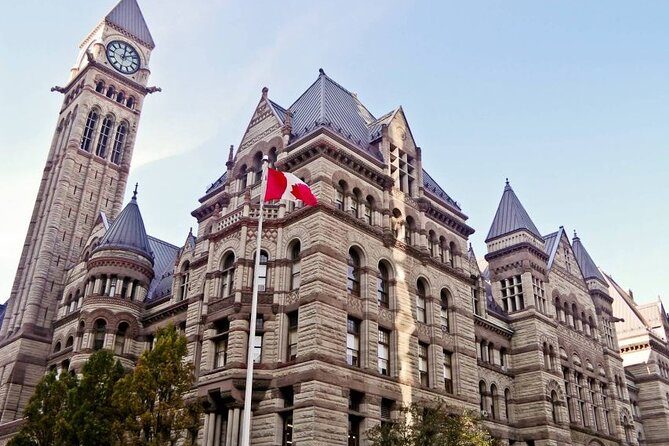
Next up is Old City Hall, a massive civic building completed in 1899 that was the largest civic building in North America at the time. It was Toronto’s third city hall, and it served multiple roles: municipal government plus courts for York County and Toronto, taking over from the Adelaide Street Court House.
In the quest, you don’t get to treat Old City Hall as a postcard. You’ll have to search the building area for the answer to your challenge, then use that to move to the TD Centre segment. That look-around requirement is key. It forces you to pay attention to the way the building announces authority—through size, form, and presence—rather than just glancing at it.
A practical note: because you’ll be focusing on the challenge, you may want to assign one person to watch for clues while another checks your app instructions. That keeps a group from all staring at the same direction and missing the next detail.
TD Centre and Oscar Peterson Place: finance-era scale, then public art
The Toronto-Dominion Centre (TD Centre) is an office complex in the Financial District owned by Cadillac Fairview. It’s the global headquarters for the Toronto-Dominion Bank and includes office and retail space across six towers plus a pavilion. The look is distinctive too: bronze-tinted glass and black painted steel.
The numbers are part of the story. About 21,000 people work in the complex, and it’s described as the largest commercial office complex in Canada. In this game, that scale turns into a fun challenge environment because you’re moving between structures and noticing how the complex is organized.
Your next puzzle stop sits between those towers at Oscar Peterson Place. Here you get two different outdoor settings: a more formal tract of granite and a lawn area. The lawn features The Pasture, a sculpture by Saskatchewan artist Joe Fafard, who died in early 2019.
This is one of those stops where the challenge format helps you slow down. When you’re actively looking for answers, you’ll naturally take in the spaces people actually use, not just the parts you’d pass by while walking faster.
Fairmont Royal York: luxury history meets a clue-based walk
The Fairmont Royal York is a shift in tone. Instead of government and offices, you’re stepping into a legacy connected to hospitality and high-profile arrivals. The hotel’s history runs nearly 90 years, and it’s hosted royal guests, heads of state, celebrities, superstars of sport, and millions of others.
For the quest, the point is not to tour the lobby like a museum. You’ll still be searching around to find the answer to your challenge, then using that to continue. That means you’ll notice the building as an object—its role in Toronto’s image and its ability to attract big names—rather than treating it as just a place to pass.
If your group likes photo stops, this is a great location to take a quick pause once the challenge is done. It’s one of those buildings where a few minutes of looking up pays off.
Hockey Hall of Fame in a former Bank building: sports history with a twist
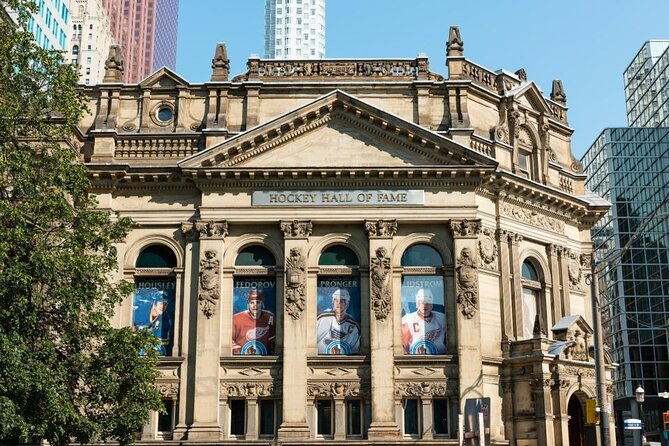
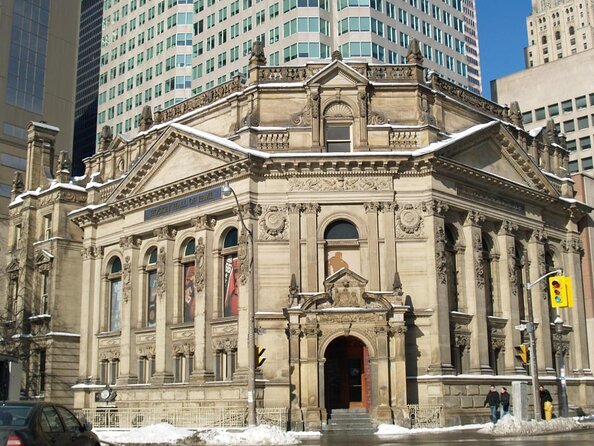
Then the route guides you to a location tied to hockey legend and international exhibitions. You’ll learn that the Hockey Hall of Fame opened its first permanent building at Exhibition Place in 1961. In 1993, the hall was relocated to downtown, and now it sits inside Brookfield Place in a historic Bank of Montreal building.
The game also highlights the museum’s role in international hockey. It has hosted IIHF exhibits and the IIHF Hall of Fame since 1998.
Why I think this stop works well in a self-guided format: relocation stories are naturally “dark history adjacent” even when the topic is sports. A building that once represented finance and power can later represent culture and public storytelling. The puzzle makes you pay attention to the setting, not only the subject.
King Edward Hotel and St. James Cathedral: architecture built to last
Next, you’ll reach the King Edward Hotel, designed by Chicago architect Henry Ives Cobb and Toronto architect E.J. Lennox for George Gooderham’s Toronto Hotel Company. It opened in 1903 with 400 rooms and 300 baths, and it claimed to be entirely fireproof. It also was granted its name from King Edward VII.
Then you move to the Cathedral Church of St. James, an Anglican cathedral in downtown Toronto. It’s especially notable for continuity: it’s the location of the oldest congregation in the city, with the parish established in 1797.
In both stops, your experience follows the same rhythm: look around to answer the challenge, then proceed. But the vibe changes fast. The hotel story emphasizes design, scale, and fireproof claims—very “engineering era.” The cathedral emphasizes long-standing community roots.
For a group, this is where I’d expect people to split into two types: the architecture watchers and the pure history seekers. The app keeps both on track since the puzzles demand attention either way.
St. Lawrence Hall to St. Lawrence Market South: finish where the city meets itself
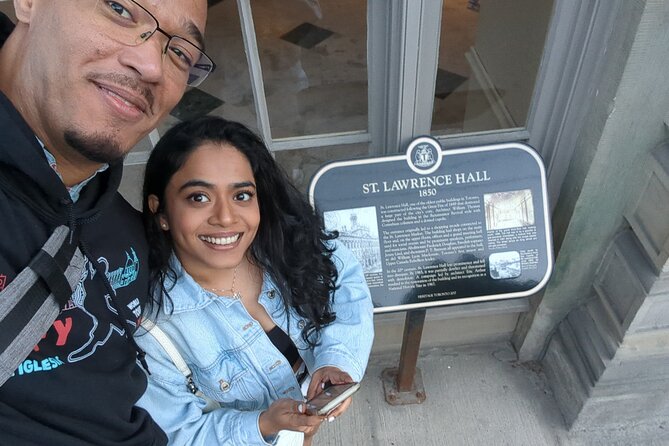
Your penultimate stop is St. Lawrence Hall, opened in 1850. It was Toronto’s first large meeting hall and named for Canada’s patron saint. For many years, it served as a center of cultural and political life in Toronto, hosting balls, receptions, concerts, exhibitions, and lectures.
Then the game ends at St. Lawrence Market South on the southwest corner of Front and Lower Jarvis Streets. This South building is a major public market building, and it’s part of a larger complex that includes St. Lawrence Market North and St. Lawrence Hall.
This ending matters because it turns the quest from “downtown history” into “real Toronto life.” After you finish the last clue, you’re in a place designed for day-to-day activity—food, browsing, and people watching. In other words, you get an exit ramp that doesn’t require you to immediately go find something else.
Price and time: value for a 90-minute self-guided dark history walk
At $8.44 per person, this is priced like an activity, not like a pricey guided tour. For that cost, you’re getting a structured storyline, 10 puzzle challenges, mobile access through the Questo app, and the ability to pause and resume. The fact that there’s no physical tour guide lowers overhead and keeps the experience simple.
Time-wise, it’s about 1 hour 30 minutes. That makes it a good option when you want history without eating your entire day. It also works well as a “connector” between other downtown plans—like if you’ve already got a museum visit nearby or you just want to start your day with a route that finishes near a classic market.
Where it fits best:
- you like self-guided travel with a clear path
- your group enjoys puzzles or light mystery-style tasks
- you want a structured walk that isn’t dependent on someone else’s schedule
Where it might not fit as well:
- you strongly prefer a live guide to explain everything without you reading anything
- your group hates looking around for clues and prefers pure sight-seeing only
Should you book this Toronto Old Town dark history walking game?
Book it if you want a smart, budget-friendly way to explore downtown Toronto from Toronto City Hall to St. Lawrence Market while staying in control of your pace. The 10 challenges turn the walk into an activity, and the pause/resume feature helps keep it from feeling stressful.
I’d also recommend it if you like history that shows up in everyday architecture—government buildings, banks turned institutions, hotels, cathedrals, and market halls. This route doesn’t just point at landmarks. It asks you to notice them.
If you do book, do one thing before you head out: plan your phone time. Download the content so you can keep moving without Wi‑Fi, and bring a little patience for the look-around parts. Once you accept that you’re the guide for your own group, the whole experience clicks.
FAQ
What is the duration of the Toronto Old Town self-guided dark history walking game?
The experience is listed as approximately 1 hour 30 minutes.
How much does it cost per person?
The price is $8.44 per person.
What does the tour include?
It includes a mobile access code, 10 puzzle challenges, storyline content about Old Town’s dark history, and the ability to pause and resume anytime.
Do I need Wi‑Fi during the walk?
No. Wi‑Fi is not needed after the initial download.
Where does the experience start and end?
It starts at Toronto City Hall, 100 Queen St W, Toronto, ON M5H 2N2, and ends at St. Lawrence Market, Toronto, ON M5E 1C3.
What language is the experience offered in?
It’s offered in English.
Is there a physical tour guide?
No, there is no physical tour guide. You’ll be guided step by step using the Questo app.
Is free cancellation available?
Yes. You can cancel for a full refund up to 24 hours in advance.